
We expect everyone participating in our activities, to respect volunteers, and fellow visitors and participants. We will not tolerate aggressive, discriminatory, disruptive, harassing or offensive behaviour. If you witness or experience behaviour you are uncomfortable with, please speak to, or contact, a Festival Volunteer who will ensure that this is dealt with and followed up appropriately with the Festival Safeguarding team.
At the Festival we will actively promote the principle of consent regarding activities on-site at events, defining consent as “someone engaging in activities if they agree by choice, and they have the freedom and capacity to make that choice” and reiterating that consent can be revoked at any time.
We are committed to improving the experience and information available for all and welcome your feedback on this journey.
Sidmouth Folk Festival is committed to the AIF Charter of Best Practice and Safer Spaces at Festivals campaign.

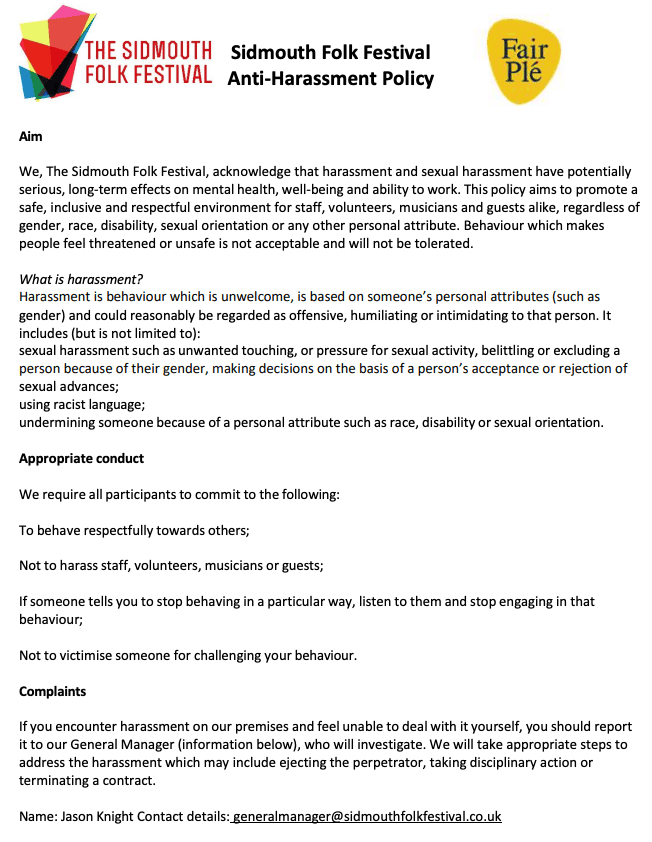
our anti-Harrassment Policy
See image below or download our Anti-Harassment Policy.
How to be an Active Bystander
Sometimes, a situation just does not feel right. It might be comments made by a friend that you feel are inappropriate or you spot someone being harassed. Being an active bystander means being aware of when someone’s behaviour is inappropriate or threatening and choosing to challenge it. If you do not feel comfortable doing this directly, then get someone to help you such as a friend or someone in authority. Research shows that bystander intervention can be an effective way of stopping sexual assault before it happens, as bystanders play a key role in preventing, discouraging, and/or intervening when an act of violence has the potential to occur.
Before stepping in, try the ABC approach
Assess for safety: If you see someone in trouble, ask yourself if you can help safely in any way. Remember, your personal safety is a priority – never put yourself at risk.
Be in a group: It’s safer to call out behaviour or intervene in a group. If this is not an option, report it to others who can act.
Care for the victim: Talk to the person who you think may need help. Ask them if they are OK.
How You Can Intervene Safely
When it comes to intervening safely, remember the four Ds – direct, distract, delegate, delay.
Direct action
Call out negative behaviour, tell the person to stop or ask the victim if they are OK.
Do this as a group if you can.
Be polite. Don’t aggravate the situation – remain calm and state why something has offended you.
Stick to exactly what has happened, don’t exaggerate.
Distract
Interrupt, start a conversation with the perpetrator to allow their potential target to move away or have friends intervene.
Or come up with an idea to get the victim out of the situation – tell them they need to take a call, or you need to speak to them; any excuse to get them away to safety.
Alternatively, try distracting, or redirecting the situation.
Delegate
If you are too embarrassed or shy to speak out, or you don’t feel safe to do so, get someone else to step in.
Any decent venue has a zero tolerance policy on harassment, so the staff there will act.
Delay
If the situation is too dangerous to challenge then and there (such as there is the threat of violence or you are outnumbered) just walk away.
Wait for the situation to pass then ask the victim later if they are OK.
Or report it when it’s safe to do so – it’s never too late to act.
In an emergency, call the police on 999.